Tampilkan postingan dengan label a19. Pit Stops. Tampilkan semua postingan

Minggu, 31 Oktober 2010

Finally the Finish Line


No matter how fast a driver is, how good his car is, and how much sponsorship money there is pushing his team towards glory, winning a Formula One race is not something that anyone can take for granted. It is the end result of an incredible amount of effort and, even with a technical advantage over your opposition, a driver still has to push himself and his team to the limit to ensure that they do not slip up.
There is a famous saying in motor racing that to finish first, first you have to finish. And doesn�t every Formula One driver out there know it. There have been countless occasions when drivers have looked all set for a spectacular victory only to have things go wrong in the final stages of the race. Formula One drivers often talk about hearing strange noises from their cars in the final laps of a race as they begin getting really paranoid of not making it to the finish.
One of the most famous times in recent history was at the 1991 Canadian Grand Prix when Nigel Mansell had dominated the race and was poised for his first win of the season. On the final lap of the race, with no challenger near him, he started waving to the crowd who were cheering him all the way. Unfortunately, on the way into a slow hairpin, he got too excited and forgot to change down a gear to get around the corner. This mistake caused his car to stall, and he was left stranded at the side of the track. His team was not happy, to say the least! That is why some drivers wait until a few short seconds before the chequered flag, knowing that if anything does go wrong with their car, they would still be able to coast across the line, before sticking their arms out of the cockpit and accepting the victory. As soon as a driver takes the chequered flag (explained in the following section), the race is over, but the spectacle isn�t � not yet anyway.
The first driver across the finish line receives the chequered flag. As the driver crosses the line to take the chequered flag, you often see him move off the racing line and swerve towards the pits. But don�t worry; he isn�t trying to scare the man waving the chequered flag. Instead, he wants to cross the finishing line and get right alongside his team members, who will be crowded onto the pit wall and cheering him on. It is a very special moment winning a Formula One race, and it�s probably the only time of the entire weekend when crew and driver can relax for a few short moments.

Winning and Losing Races in the Pits


Races can be won or lost in the pits through the timing of the stops, through the pit crew�s performance, or through malfunction. The timing of the stops is decided by the race strategists; the time taken for the actual stop is determined by the amount of fuel delivered and the efficiency of the pit crew. The most frequent cause of a pit stop delay is an equipment problem.

Timing of stops
Before the race, the team strategists will have worked out an ideal plan of action. This plan is based on the characteristics of the track, the car�s grid position and the grid position of the main. But once the race gets underway, the strategy can be fine-tuned by tactics.
If a rival holds up a driver for example, it may be advantageous to pit early and hope to set a strong enough pace immediately after the stop to pass the rival when he makes his stop. On the other hand, being able to run longer than your rival before pitting may find you the winning margin. In this scenario, your driver may be able to put in the critical fast laps after the rival has pitted; these laps could enable your man to rejoin ahead after he makes his own pit stop.
Changeable weather during the race brings all sorts of opportunities for winning pit tactics too.

Crew performance
Getting the whole crew to put in an error-free performance is the first prerequisite here. Under the most extreme pressure, the wheel guys have to ensure they don�t cross-thread a wheel nut and that the correct tyres goes on the correct side of the car; the jack man mustn�t miscue his lift; and so on. Although all crew members must perform at their peak, how quickly the refuellers can attach the hose, refuel, and disconnect is really the critical path to how quick the stop is. The fuel goes in at a pre-determined rate and the wheel changing takes up only a fraction of the time of the refuelling. So, assuming nothing goes wrong, it all hangs on how quickly those two refuellers can do their stuff. In a closely matched race, the time they take can be the difference between winning and losing.
Stalling due to driver error at the pit stops is now largely a thing of the past as they use their launch control electronics to get them underway.


Equipment malfunction

Typical malfunctions that have cost teams races include sticking wheel nuts �where the expansion of the metal due to heat causes the nuts to seize on their splines � and problematic refuelling rigs. The standard fuel rigs have proved notoriously temperamental and have frequently failed to deliver the programmed amount of fuel, for example. For this reason, teams usually have the other car�s rig on stand-by just in case, with a third refueller manning it, ready for action.
Faulty connections on the steering wheel controlling the launch control can also cause the car to stall. This lost Jacques Villeneuve over a lap in the 2003 Austrian Grand Prix and lost him what had been a real chance of finishing in the points.

Selasa, 31 Agustus 2010

Safety and danger in the pits


A highly charged competitive environment compressed into a narrow pit lane where cars share space with crew members and where raw fuel is in close proximity to red hot engines and exhausts makes for a potentially lethal combination.
But while no-one can deny that a Formula One pit lane is a fundamentally unsafe environment, strict safety rules play their part in keeping things under control. These include the following:
  • Pit lane speed limit: The speed limit during pit stops is 60 km/h during practice and qualifying, 80 km/h during the race (60 km/h at Monaco). This limit was introduced in 1994 after a mechanic was injured in the Imola pit lane.
  • Rules against going in reverse: Reversing in the pit lane is prohibited. If a car needs to be moved backwards, the crew must push it.
  • Restriction on numbers of personnel in the pit lane: The crew of the competing cars are only allowed out of their garages and into the pit lane on the lap preceding their car�s pit stop. Other than officials, these are the only people allowed in the pit lane during the race. After the stop, they must return to their garages.
  • Fire-resistant clothing: All pit crew members wear fire-resistant Nomex suits similar to those used by the drivers. These suits can withstand heat of up to 800 degree C for 12 seconds. In addition, the pit crew must wear full-face crash helmets for further protection from fire.
  • Limited fuel pressurisation: Fuel delivery is limited to 12 litres per second, outlawing the high-pressure refuelling used in previous years. This rate of delivery produces a limited pressure that reduces the chances of spillage and fuel nozzle or rig failure compared to the old high pressure systems.
  • Standardised safety valves for rigs, hoses, and fillers: In addition to the dead man�s handle on the fuel rig (this handle ensures that fuel flow stops the moment pressure is released on the handle) the inlet valves and fillers are standardised and designed in such a way as to prevent leakage of inflammable vapours. A two-way system equalises pressure as the fuel is delivered.
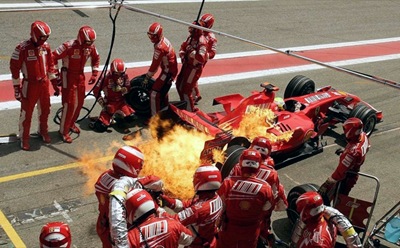
  • Things can still go wrong though, as demonstrated by Ferrari in the 2003 Austrian Grand Prix when flames erupted from the filler of Michael Schumacher�s car during a routine stop. This was later traced to a faulty seal.

Pit Stop Basics


Pit stops have become one of the most tense and exciting features of a Grand Prix, and races are frequently won and lost in this high pressure environment. Amazingly for a sport that is all about speed, for between 7 and 12 seconds (the time of an average pit stop), a stationary car becomes the focus of all attention, the most interesting thing that is happening in the race. The pit stop has also emphasised the team play aspect of Formula One making individual team members such as jack men and refuellers highly visible as part of a winning effort. Most of all, the pit stop has underlined the intellectual challenge of Formula One racing. The reason is that race strategies based on the timing and number of pit stops have assumed greater significance, and pit stops can have a huge effect on the outcome of the race. Pit stops are an intrinsic part of modern Formula One. They aren�t compulsory, but dividing the race into stints punctuated by pit stops and thereby having a relatively small amount of fuel on board at any given time is by far the fastest way to get a car through a Grand Prix race distance. This advantage is amplified by the fitting of new tyres during a refuelling stop. There is never any question of whether to have a pit stop or not. The only question is how many.
The pits is the name of the area between the race track and the garages where the team are based for the duration of the race. This area is called the pits because originally, in the dim and dusty past, there was a pit dug out of the track surface where the team personnel would sit and signal their drivers. Originally only this actual pit delineated the working area from the race track. In more modern times, the areas have been separated by a pit wall, and it is now in this area that the selected team members � usually the team principal and two or three race strategists � base themselves during the race. Across the other side of the pit lane the rest of the team � engineers, data loggers, and pit crew � sit in the team garages.

Jumat, 30 April 2010

Things to Consider when Fueling a F1 Car

Both factors vary from track to track. Here are the vital pieces of information the teams will take into consideration:
  • The way you qualify. Because fuel cannot be added or subtracted between Saturday qualifying and the race, the cars have to qualify with enough fuel on board to do the first stint of the race. Obviously a car planning to three-stop can qualify lighter than one on a two-stop strategy. The team needs to trade off the importance of qualifying position with the optimum race strategy.
  • The weight of fuel. This varies according to how dense the fuel is, but the regulations specify the density must be between 0.725 and 0.77kg per litre. The largest tanks hold around 150 litres and brimmed to capacity will therefore weigh around 120kg.
  • The amount of lap time this costs at the track in question. A half-tank car is quicker by around 2.4 seconds per lap around Suzuka than a full tank one, whereas over the similar distance of a Monza lap � with long straights and not many corners � the difference is only around 1.6 seconds. Suzuka therefore errs towards a two-stop strategy, Monza a one-stop.
  • The consumption of fuel. How much fuel (and therefore weight) needs to be put into the tank and how much the car sheds as it races tends to be higher at a track with lots of accelerating, braking, and use of the lower gears. The Hockenheim track, as revised from 2002, induces heavier fuel consumption than any other on the Formula One calendar. Although lap times at the track are only averagely sensitive to weight changes, the big reduction in weight (because of the high fuel consumption) means that the total effect is large. It�s therefore another track favouring a two-stop strategy. At the other end of the pole is Nurburgring where there is relatively gentle fuel consumption but where lap times are highly sensitive to weight. The net result is very similar, and again a two-stop is favoured.
  • Your qualifying position. If your grid position places you in an attacking position � meaning that you need to overtake other cars � you are more likely to opt for an aggressive two-stop strategy, even if the maths tells you that a one-stop is quicker. If it�s a track where pretty much everyone can be guaranteed to be on the same number of stops, you have a choice: depending on whether your strength is early or late in the stint, you can either short-fuel for the first stint, using your lower weight to pass cars and then hope to pull out enough of a time cushion before you stop to keep you ahead after they have stopped. Or you might choose to take on board as much fuel as you dare and hope you can keep up with cars that are lighter early in the race; when you stop later it will take less time as you will not spend as much time refuelling to get you to the end.
  • Other cars and overtaking opportunities. The more pit stops you make, the more you are at the mercy of traffic � of getting caught behind slower cars after your stop but before they make theirs. At a track with plenty of overtaking opportunities this is less of a consideration than at a place like Monaco where passing places are few and far between. The timing of your stop might also be influenced by traffic � for example, you might come in earlier than planned so as to avoid encountering a bunch of lapped cars.
  • How the brakes are wearing. At some circuits � such as Imola, Montreal and Monza � brake wear is extreme. A heavier fuel load places extra strain on the brakes, due to the extra weight and momentum that they are working against.
  • The skill of the driver. The handling balance of the car changes a lot from the beginning of a stint to the end. This change will be larger the longer the stint. Some drivers can cope with handling changes better than others, so it is something that has to be taken into account.

Rabu, 31 Maret 2010

Refuelling stops


A Formula One car with a big enough fuel tank to do a full Grand Prix distance of 190 miles (305km) would be hopelessly slow. Not only would the car be very heavy at the start of the race, but it would also be aerodynamically inefficient because the fuel tank, which would need a capacity of around 330 litres, would have to be huge. The primary reason for pitting then is to refuel the car. During the fuel stop, teams also routinely check the tyres. As well as having fresh tyres fitted, the driver may take the opportunity of making other changes to the car while he is being refuelled.
The car�s handling may have changed since the car was set up before qualifying the day before. Maybe the car is now understeering too much for the driver�s liking. A quick cure would be to have some extra angle put on the front wing, something that can be accomplished in just a few seconds �usually less than the time taken to refuel.
The driver may have set his car up for the best possible lap time in qualifying, with quite high downforce levels, but he may now be finding that he needs more straight-line speed in order to defend his position in the race. In this case front and rear wing angles might be reduced. Again, this would take less time than is needed to refuel the car.
Depending upon the nature of the circuit and how much lap time penalty there is for a given weight increase, the main question is how many pit stops to make. Traditionally, most circuits have been best suited to two-stop strategies. However, the 2003 regulations stating that no fuel can be added or taken away between qualifying and race mean that three stops are now quite common in order to have the cars as light as possible in qualifying.

Safety and danger in the pits


A highly charged competitive environment compressed into a narrow pit lane where cars share space with crew members and where raw fuel is in close proximity to red hot engines and exhausts makes for a potentially lethal combination.
But while no-one can deny that a Formula One pit lane is a fundamentally unsafe environment, strict safety rules play their part in keeping things under control. These include the following:
  • Pit lane speed limit: The speed limit during pit stops is 60 km/h during practice and qualifying, 80 km/h during the race (60 km/h at Monaco). This limit was introduced in 1994 after a mechanic was injured in the Imola pit lane.
  • Rules against going in reverse: Reversing in the pit lane is prohibited. If a car needs to be moved backwards, the crew must push it.
  • Restriction on numbers of personnel in the pit lane: The crew of the competing cars are only allowed out of their garages and into the pit lane on the lap preceding their car�s pit stop. Other than officials, these are the only people allowed in the pit lane during the race. After the stop, they must return to their garages.
  • Fire-resistant clothing: All pit crew members wear fire-resistant Nomex suits similar to those used by the drivers. These suits can withstand heat of up to 800 degree C for 12 seconds. In addition, the pit crew must wear full-face crash helmets for further protection from fire.
  • Limited fuel pressurisation: Fuel delivery is limited to 12 litres per second, outlawing the high-pressure refuelling used in previous years. This rate of delivery produces a limited pressure that reduces the chances of spillage and fuel nozzle or rig failure compared to the old high pressure systems.
  • Standardised safety valves for rigs, hoses, and fillers: In addition to the dead man�s handle on the fuel rig (this handle ensures that fuel flow stops the moment pressure is released on the handle) the inlet valves and fillers are standardised and designed in such a way as to prevent leakage of inflammable vapours. A two-way system equalises pressure as the fuel is delivered.
Things can still go wrong though, as demonstrated by Ferrari in the 2003 Austrian Grand Prix when flames erupted from the filler of Michael Schumacher�s car during a routine stop. This was later traced to a faulty seal.

Minggu, 28 Februari 2010

The Pit Crew


Up to 20 pit crew are allowed to service the car during a pit stop. Typically these include the following:
  • Two men at each wheel who work in concert to change the tyres
  • A front jack man who raises the front end of the car
  • A rear jack man who raises the rear of the car and restarts the motor if it stalls
  • A lollipop man, who drops the lollipop in front of the car to signal where it should stop
  • Three refuellers (including one on stand-by) who add the necessary fuel
  • Two fire extinguisher men who stand by in case of a fire
  • Maybe a visor cleaner (some drivers prefer not to have one) who wipes the visor of the driver�s helmet In addition, a team manager usually oversees the whole operation.
That leaves a couple of spare pit crew to do any changes to the car such as wing settings. With the exception of the team manager, the pit crew usually double up as mechanics. No formal qualifications exist that specify who can or can�t be a member of the pit crew, but crew members are invariably fully trained as mechanics. The lollipop man is often the chief mechanic. During a pit stop these folks move in high gear. Each has a job to do and must do it quickly and well.
Between pit stops the pit crew gets to sit down in the pit garage and watch the race on the monitors. They swear when their driver messes up or make rude signs at the screen when he�s not assertive enough in dealing with another driver. They make friendly banter with each other. This is one of the few chances they get over the whole weekend to relax.

Pit Stop Basics


Pit stops are an intrinsic part of modern Formula One. They aren�t compulsory, but dividing the race into stints punctuated by pit stops and thereby having a relatively small amount of fuel on board at any given time is by far the fastest way to get a car through a Grand Prix race distance. This advantage is amplified by the fitting of new tyres during a refuelling stop. There is never any question of whether to have a pit stop or not. The only question is how many.
The pits is the name of the area between the race track and the garages where the team are based for the duration of the race. This area is called the pits because originally, in the dim and dusty past, there was a pit dug out of the track surface where the team personnel would sit and signal their drivers. Originally only this actual pit delineated the working area from the race track. In more modern times, the areas have been separated by a pit wall, and it is now in this area that the selected team members � usually the team principal and two or three race strategists � base themselves during the race. Across the other side of the pit lane the rest of the team � engineers, data loggers, and pit crew � sit in the team garages.